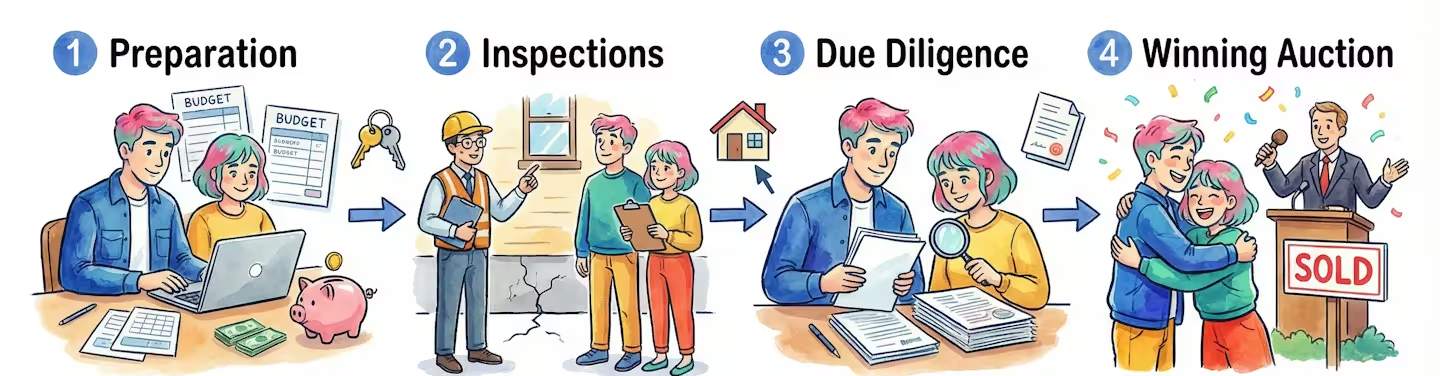
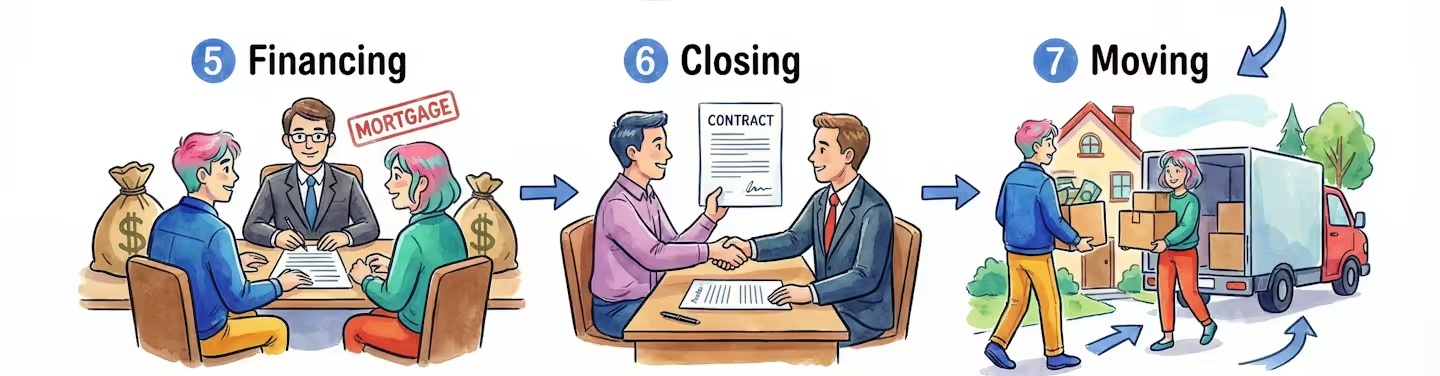
Pre-Purchase Preparation
Before you set foot in a single open home, there's some essential groundwork to lay. This checklist for first homebuyers and experienced buyers alike starts well before you walk through a front door — because the buyers who get the best results aren't the ones who act fastest, they're the ones who show up prepared.
Check and Improve Your Credit Score
Your credit score is the first thing any lender will look at when you apply for a home loan, so understanding where you stand before you start shopping is non-negotiable. In Australia, you can access your credit score for free through services like ClearScore, Equifax, and Experian. Each service uses slightly different scoring models, so it's worth checking more than one.
A score above 700 is generally considered good, while anything above 800 puts you in excellent territory and gives you real negotiating power with lenders. If your score is lower than you'd like, paying down existing debts, avoiding multiple credit enquiries in a short period, and ensuring there are no errors on your credit file can all make a meaningful difference within a few months.
Keep in mind that every time a lender does a "hard" credit enquiry — such as when you apply for a credit card or personal loan — it leaves a mark on your file. If you're planning to apply for a home loan in the near future, now is not the time to open a new credit account or finance a car.
Determine Your Budget and Affordability
Before you fall in love with a property that's $200,000 above what you can actually borrow, take the time to properly understand your borrowing power. Most of Australia's major banks — including CommBank, Westpac, ANZ, and NAB — offer free online home loan borrowing calculators that give you a high-level estimate based on your income, expenses, and existing debts.
Treat these figures as a starting point, not a guarantee. APRA (the Australian Prudential Regulation Authority) requires lenders to stress-test your repayments at a rate roughly 3% above the actual loan rate, which means your borrowing capacity can be lower than you might expect.
Beyond the purchase price, factor in stamp duty (which varies by state), conveyancing fees, building inspection costs, moving expenses, and the inevitable round of purchases in the first few months — from new curtains to a lawnmower.
Save for a Deposit (Typically 20%)
In Australia, the standard deposit is 20% of the purchase price — which on a $750,000 home means you need $150,000 in cash before you even consider borrowing. Anything below that threshold typically triggers Lender's Mortgage Insurance (LMI), a one-off premium that protects the lender — not you — in the event you default. LMI can cost anywhere from a few thousand dollars to well over $20,000.
That said, a 20% deposit is not always achievable — or necessary. Many lenders will accept deposits as low as 5% to 10%, and if you're eligible for the federal government's First Home Guarantee, you may be able to purchase with just a 5% deposit without paying LMI at all. Single parents accessing the Family Home Guarantee can buy with as little as 2% deposit. Check the current eligibility criteria on the National Housing Finance and Investment Corporation (NHFIC) website.
Research First-Home Buyer Programs
Australia has a range of federal and state government programs specifically designed to help first-home buyers. At the federal level, the First Home Guarantee, the Regional First Home Buyer Guarantee, and the Family Home Guarantee allow eligible buyers to purchase with a low deposit without paying LMI. The First Home Super Saver Scheme (FHSSS) lets you save for a deposit inside your superannuation fund, taking advantage of the concessional tax treatment super contributions receive.
At the state level, there are various First Home Owner Grants (FHOG), stamp duty concessions, and exemptions that can significantly reduce your upfront costs. In Victoria, the FHOG of $10,000 applies to new homes only, while stamp duty exemptions apply to both new and established properties up to certain price thresholds. Check your state revenue office's current offerings — these programs are updated regularly.
Get Pre-Approved for a Mortgage
Pre-approval (sometimes called conditional approval) is a lender's written indication of how much they're willing to lend you before you've found a specific property. Getting pre-approved tells you exactly what your realistic budget is, signals to vendors and agents that you're a serious buyer, and in a competitive market it can make the difference between getting the keys and missing out.
The process typically involves submitting your financial documents to a lender — or working with a mortgage broker who can submit to multiple lenders simultaneously. Mortgage brokers have access to a wide panel of lenders, including not just the big four banks but also neo lenders like Athena, Unloan, and Tic:Toc, which often offer sharper rates. Pre-approval is usually valid for 90 days, so timing matters.
Consider a Buyer's Agent
If you're entering a competitive market, or buying in a suburb you're not intimately familiar with, a buyer's agent can be one of the smartest investments you make. Unlike the selling agent — whose legal obligation is to the vendor — a buyer's agent works exclusively in your corner.
One of the biggest advantages is access to off-market properties: homes that are sold before they're ever advertised publicly. Buyer's agents often have established relationships with selling agents and developers, which means their clients get first look at properties the general public never sees. They also bring professional negotiation skills to auction bidding, where emotional pressure can easily push you above your limit.
Define Must-Haves vs. Nice-to-Haves
This sounds obvious, but it's a step that many buyers skip — and then regret. Sit down and write two clear lists before you start inspecting: the things you absolutely cannot live without, and the things that would be lovely but aren't dealbreakers. Number of bedrooms, proximity to public transport, a garage, a north-facing backyard — decide in advance, with your partner if applicable, so you're not making these decisions under pressure at an open home.
In Australian capital cities, good properties in desirable suburbs can attract multiple offers within days of listing. Buyers who haven't thought through their priorities tend to hesitate — and hesitation costs deals.
Research and Select Target Suburbs
Don't just pick a suburb because it sounds nice or a friend lives there. Look at infrastructure plans, crime statistics, flood and bushfire risk maps, local council rates, and proximity to the amenities that matter to your lifestyle. The CoreLogic and PropTrack suburb profiles (accessible via realestate.com.au and Domain) offer median prices, days on market, and auction clearance rate data that paint a clear picture of where a market is heading.
Visit target suburbs at different times of day and on different days of the week — a street that feels quiet on a Saturday morning can look very different on a Wednesday evening.
Inspection
Walking through a property at an open home is not the same as a proper home inspection checklist review. Use this home checklist to assess every room and structural element systematically — here's exactly what to look for.
Walls Condition
Not all wall cracks are equal. Hairline cracks in plaster are common in older Australian homes and usually just reflect normal settling. What you're looking for are diagonal or stair-step cracks in brickwork — particularly around windows and door frames — which can indicate structural movement in the foundations.
As a rough rule of thumb, cracks wider than 2mm to 5mm deserve attention. Sight along walls from end to end — any bowing or bulging is a serious warning sign. Separation between the wall and the ceiling or floor junction is also a red flag. If you're seeing multiple large cracks, get a qualified building inspector in before you commit to anything.
Floors Condition
Walk the entire house slowly and deliberately — feel for floors that bounce, sag, or feel soft underfoot. Uneven or sloping floors can indicate foundation settlement, especially in older homes built on reactive clay soils, which are common across much of south-eastern Australia.
Check for gaps between floorboards and the skirting boards, squeaky boards that might indicate moisture damage, or soft spots in timber floors that suggest rot. For homes built on a concrete slab, look for large or uneven tile cracks, and check carpet edges for dampness that may indicate rising damp underneath.
Ceiling Condition
Look up. A sagging or drooping ceiling section is almost always a sign of water damage — either from a leaking roof or a plumbing failure in the ceiling cavity. Water stains and discolouration are immediate red flags, even if they look old and dry. Previous owners may have painted over the stain, so don't assume a clean-looking ceiling tells the whole story.
Check the cornice — the decorative join between wall and ceiling — for cracks or separation. In homes with older plasterboard or fibrous cement sheeting ceilings, look for areas that appear to be pulling away from the framing above.
Wet Areas Condition
Bathrooms, kitchens, and laundries are the most vulnerable parts of any home to water damage, and the most expensive to repair. Look carefully at flooring adjacent to these wet areas — warped, buckled, or spongy flooring next to a bathroom is a classic sign of water ingress, usually from a shower recess that hasn't been properly waterproofed.
Water damage in wet areas is particularly common in Australian homes built between the 1970s and early 2000s, before waterproofing standards were tightened. Check around the base of toilets, beneath vanity cabinets, and under kitchen sinks.
Visible Mould
Mould is more than an aesthetic problem — it's a health issue, and in some cases a sign of serious structural moisture problems. Black or green patches in bathrooms or laundries are often just a ventilation problem, but mould near windows, on external walls, or in areas with no obvious moisture source warrants closer investigation.
Look for efflorescence — the white, powdery salt deposits that appear on brickwork when water moves through the wall. This is a reliable indicator of rising damp, which is both expensive to fix and damaging to the building's structure over time. Trust your nose too: a persistent musty smell in a property that otherwise looks fine is worth taking seriously.
Roof Condition
Look for cracked, slipped, or missing tiles on a tiled roof, or rust, lifted edges, or holes on a metal roof. Check the ridge capping (the row of tiles along the peak of the roof) for gaps or deterioration — failed ridge capping is one of the most common entry points for water.
Moss and lichen growth on roof tiles may look picturesque, but it's a sign of prolonged moisture retention that can degrade tiles from underneath. Roof replacement is among the most expensive repairs an Australian homeowner faces — a full re-roof on a typical suburban home can cost $15,000 to $40,000 or more.
Layout and Floorplan
Think carefully about whether the layout actually works for your life. North-facing living areas are genuinely valuable in the Australian climate — they receive sun in winter when the sun is low, and can be shaded by eaves in summer when it's high, making a home naturally warmer in winter and cooler in summer without relying on heating and cooling systems.
Think about storage: adequate walk-in wardrobes, linen closets, and a pantry are things that seem fine during an inspection but become daily frustrations once you're living there. Also consider bedroom separation — in a family home, having children's bedrooms adjacent to the main living area serves no one well in the long run.
Slope on the Land
Land slope affects not just the cost of building but also drainage, outdoor usability, and the structural requirements of any future extension. A rise or fall of up to 3 metres across the building area is considered relatively manageable. Beyond that, costs for cut and fill, retaining walls, and specialised footings increase substantially.
If the property has an existing retaining wall, inspect its condition carefully — a failing retaining wall is an expensive fix and a potential safety hazard. Ask the vendor or your conveyancer whether there are any engineering reports or council approvals related to existing earthworks.
Large Trees on the Property or Near the Fence
Large trees — particularly gum trees (eucalypts) — are a feature of many Australian backyards, but they come with significant responsibilities. Under stress from drought or disease, gum trees can drop large limbs without warning. Tree roots can also infiltrate underground pipes, crack driveways and footpaths, and lift concrete slabs.
Many councils maintain Tree Preservation Orders (TPOs) that prohibit the removal or significant pruning of certain trees without council approval. Before buying, check with the local council whether any trees on the property are subject to a TPO — you may be inheriting a maintenance obligation along with the property.
Fence Condition
Under Australian law, fencing costs are typically shared equally between neighbouring properties. That means if the boundary fence is on its last legs, you could be up for half the bill soon after moving in.
Inspect timber fences for rot at the base of posts — this is the most common failure point. For Colorbond fences, check the bottom rail for rust, which tends to accumulate where soil meets metal. Look for leaning panels, sagging gates, and posts that move when pushed.
Due Diligence
This is where serious buyers separate themselves from the rest. Use this section of your home buyer checklist to cover the research phase that protects you from buying a property with hidden problems — legal, environmental, or financial.
Check the Planning Zone
The planning zone of a property determines what you can legally do with it. Zones range from residential (with various density categories) to commercial, industrial, and rural — each with its own set of permitted and prohibited uses. This affects everything from whether you can build a granny flat, to whether you could eventually subdivide, to whether the neighbouring block could one day become a four-storey apartment building.
In Victoria, planning zone information is available on Planning Maps Online. In NSW, it's accessible via the NSW Planning Portal. Queensland uses MyMaps QLD. You can also find this in the Section 32 Vendor Statement — your conveyancer should review this as part of their standard service.
Check Planning Overlays
Planning overlays sit on top of zoning and add additional controls specific to that property or area. Common overlays include heritage overlays, bushfire management overlays, flood overlays, and design and development overlays. A property can have multiple overlays simultaneously.
A heritage overlay, for example, restricts what changes you can make to the exterior of a home — sometimes even to colour schemes — and may require council approval for works that would normally be permit-exempt. A bushfire management overlay may dictate construction standards and landscaping requirements.
Check for Cultural Heritage Sensitivity
If a property is heritage-listed — either at a local or state level — you take on legal obligations as the new owner. Heritage-listed property owners are required to maintain the building and ensure it does not fall into disrepair. Failure to comply can result in the relevant Heritage authority issuing a repair order, and significant penalties apply if those repairs are not completed.
Heritage controls vary between jurisdictions and even between councils. If you have grand plans to modernise a period home, a heritage overlay may mean those plans require council approval — or may not be possible at all.
Check Hazard Risks — Flooding, Bushfires, and Landslides
Australia's climate makes hazard risk a genuine consideration, particularly in coastal, rural fringe, and bushland areas. Flood risk can be identified through flood overlays in state planning portals as well as council flood maps. Bushfire risk is mapped through the relevant state planning authority, and properties in Bushfire Attack Level (BAL) zones have mandatory construction standards that add cost to any building work.
It's also worth checking with your prospective home insurer before you commit to purchase. In high-risk areas, premiums can be dramatically higher than standard — or insurers may decline to offer cover at all. Finding out after settlement that your home is uninsurable is a situation you want to avoid entirely.
Review Easements on the Property
An easement is a legal right for another party — typically a utility company or local council — to use part of your land for a specific purpose. Common easements include rights of way for water and sewerage pipelines, drainage easements, and power line corridors. They're noted on the title and disclosed in the Section 32 Vendor Statement.
Easements restrict how you can use that part of your land. You generally cannot build a permanent structure over an easement, and the utility company has the right to access the land to maintain its assets. Yarra Valley Water in Victoria, for example, offers a Pipeline Tracker tool that shows the location of its assets relative to any property address.
Professional Building and Pest Inspection
If there's one item on this entire list that you should never skip, it's this one. A professional building and pest inspection — typically $400 to $800 — is the single most important piece of due diligence you can do before signing a contract of sale.
The pest inspection specifically looks for termite activity — which is critically important in Australia, where termites cause more damage to homes each year than fire, floods, and storms combined. A termite infestation can be invisible to an untrained eye and cause catastrophic structural damage. Pest inspectors use thermal imaging and moisture meters to detect activity you'd never spot on a walk-through. An inspection report also gives you negotiating leverage — significant issues found can justify a price reduction or vendor repairs before settlement.
Confirm School Zones for Public Schools
Real estate listings frequently display school information that is either incorrect or misleading — schools are mentioned for marketing purposes without verification of actual catchment boundaries. Never rely on the listing; always confirm the catchment yourself using the official government school zone checker for your state.
Being in catchment for a sought-after public school can add meaningful value to a property and is a significant consideration for resale — even if you don't have children.
Check School Ratings
For a broader picture of school performance, NAPLAN results — the national standardised test taken by students in Years 3, 5, 7, and 9 — are publicly available. Sites like My School (the official ACARA platform) and Better Education aggregate NAPLAN data alongside other metrics to give an overall sense of a school's academic performance.
Proximity to quality schools is one of the most consistently significant drivers of property values in Australian suburbs. Properties within catchment of high-performing public schools tend to hold their value better and attract more buyers when it comes time to sell.
Review a Property Research Report
An Australian property research report pulls together suburb-level data — median sale prices, days on market, vendor discount rates, rental yields, and vacancy rates — to give you a comprehensive picture of the market dynamics in your target area. It can also include property-specific risk information like bushfire and flood overlays.
The big four banks all offer free property reports, and independent services like Aussie, CoreLogic, and PropTrack provide detailed suburb snapshots. A long days-on-market figure often means vendors are overpricing and there's room to negotiate.
Swimming Pool Compliance
If the property has a pool, don't take compliance for granted. In most Australian states, pool and spa registration and compliance certificates are required by law — and the rules around fencing, gates, and barriers are strict. Non-compliance is a legal liability for the new owner from the moment settlement is complete.
In NSW, pools must be registered on the NSW Swimming Pool Register. If a pool is non-compliant, factor the cost of rectification into your offer and confirm with your conveyancer who is responsible for achieving compliance.
Check Commute Options
Before you commit to a suburb, spend time actually doing the commute you'd be doing every day. What looks manageable on a map can be genuinely punishing in practice. Check Public Transport Victoria, Transport for NSW, or your relevant state authority's journey planner for options and travel times. If you're driving, test the route at peak hour — not on a Saturday morning.
Auction or Private Offer
Whether you're buying at auction or through a private treaty, the contract review and offer process deserves careful attention.
Review the Contract with a Conveyancer
A conveyancer is a licensed professional who specialises in the legal transfer of property ownership. Engaging one before you make an offer — not after — is the right approach. They'll review the contract of sale and the Section 32 Vendor Statement (in Victoria) or equivalent vendor disclosure document, checking for anything unusual in the title, terms, or conditions that could disadvantage you.
Conveyancers also manage the cooling-off period — the window after signing a contract during which you can withdraw, subject to a small financial penalty. Note that cooling-off rights do not apply to properties purchased at auction.
Review Special Conditions with Your Conveyancer
Most contracts of sale include special conditions — clauses added by the vendor or their solicitor specific to that transaction. Some are relatively benign (specifying which chattels are included in the sale), while others can significantly affect your rights or obligations. Your conveyancer will read these carefully and flag anything that warrants discussion.
Don't assume that because a condition is written into a contract, it's reasonable or standard. Special conditions are negotiable in a private sale context, and your conveyancer can advise on whether to accept, amend, or push back on any specific clause.
Consider a Conditional Offer
For a private sale, you can make your offer conditional on the satisfaction of certain requirements before being bound to complete the purchase. Common conditions include: subject to finance (giving you time to obtain formal loan approval), subject to a satisfactory building and pest inspection, and occasionally subject to the sale of your existing property.
Understand that a conditional offer may be less attractive to a vendor than an unconditional one — particularly in a competitive market. Discuss the tradeoffs with your conveyancer and buyer's agent if you have one.
Add a Validity Period to Your Private Offer
When making a private offer, always include a validity period — typically two to three business days. This creates a deadline for the vendor to respond, preventing them from using your offer to pressure other potential buyers without any obligation to come back to you. Without a validity period, an offer can sit indefinitely, leaving you in limbo.
Prepare for the Auction
Buying at auction is a distinctly different experience to private treaty, and preparation is everything. Set a firm upper limit before the day — not a rough figure you'll reconsider in the heat of the moment, but a hard ceiling — and commit to it. Have your minimum deposit (typically 10% of the purchase price) available in your account ready to transfer on the day, because at auction, the contract is unconditional the moment the hammer falls.
Make sure your conveyancer has reviewed the contract before auction day, because you have no cooling-off period after an auction purchase. If you're nervous about bidding, consider engaging a buyer's agent to bid on your behalf — having a composed, experienced bidder representing you can make a genuine difference to both your strategy and your nerves.
Financing and Insurance
Shop for a Home Loan
The Australian home loan market is highly competitive, and shopping around properly can save you tens of thousands of dollars over the life of a loan. Don't default to your existing bank out of loyalty — compare rates across the big four and the growing field of neo lenders like Athena, Tic:Toc, and Unloan, which often have lower overheads and pass those savings on as sharper rates.
Comparison websites like Finder, Canstar, and Compare the Market let you filter by rate, features, and loan type. A mortgage broker can do the heavy lifting for you — accessing a panel of lenders, comparing products, and handling the application process. Brokers are paid by the lender rather than by you.
Provide All Required Documents to Your Lender
Lenders require a comprehensive document package: identification (passport, driver's licence, citizenship certificate), proof of income (recent payslips and a PAYG Summary, or business tax returns if self-employed), proof of expenses (recent bank statements — usually three to six months), an assets and liabilities statement, and eventually the signed contract of sale.
Getting your documents together in advance significantly speeds up the approval process. Delays in documentation are one of the most common reasons home loan approvals miss settlement deadlines.
Get Your Home Loan Approved
Formal loan approval is the lender's written commitment to provide the funds for a specific property. As part of this process, the lender will conduct a property valuation — desktop (automated), kerbside, or full physical valuation by a registered valuer.
Occasionally, a lender's valuation comes in below the purchase price. This is known as a valuation shortfall, and it means the lender will only lend against the lower figure — leaving you to cover the gap from your own funds. If you're purchasing in a hot market, a valuation shortfall is a genuine risk worth planning for.
Buy Homeowners Insurance
Home and contents insurance should be in place from the moment you become legally responsible for the property — in most states, this is from the moment contracts are exchanged, not from settlement. Don't leave this to the last minute.
Pay close attention to the sum insured — the amount you nominate to rebuild your home from scratch. Underinsurance is a widespread problem in Australia: many homeowners insure their property for its market value rather than its rebuild cost, and these figures can be very different. Check whether flood and bushfire cover are standard inclusions or optional extras — in high-risk areas, an uninsured loss is financially catastrophic.
Settlement
Settlement is largely handled by your conveyancer and takes place electronically via the PEXA platform — Australia's national electronic settlement system that facilitates the simultaneous transfer of funds and title. Stay contactable throughout the day in case your conveyancer needs a quick decision.
Conduct your final inspection one to three days before settlement to confirm the property is in the same condition as when you signed the contract, that all included chattels are present, and that no damage has occurred. Once settlement is confirmed, collect the keys from the real estate agent's office.
Moving In
School Enrolment
If you have school-aged children, confirm your catchment school's enrolment process well before moving day. Many schools — particularly popular ones — have enrolment deadlines, especially if you're looking to start at the beginning of the school year. Contact the school directly and bring proof of address (your settlement statement or utility connection letter will work).
Update Your Australian Electoral Enrolment
Electoral enrolment is compulsory for Australian citizens, and failing to update your enrolment after moving can result in a fine. Visit the AEC (Australian Electoral Commission) website and update your details online in a few minutes. Do it in the first week after you move so it doesn't slip through the cracks.
Book Movers
Research removalist companies early — particularly if you're moving around end-of-month dates, school holidays, or over summer, when demand is highest. Get at least three quotes, check reviews, and confirm whether your quote includes packing materials, disassembly of furniture, and insurance coverage for your belongings in transit.
Book Connection for Electricity and Gas
Contact energy retailers to arrange connection at your new address before moving day — don't arrive to a dark, cold house. Australia's energy market is deregulated in most states, which means you can choose your retailer. Use a comparison site like Energy Made Easy (the government's comparison tool) to find competitive rates for your location.
Book Your NBN Internet Connection
The lead time to get connected can be longer than you'd expect, particularly if technician installation is required. Check your new address on the nbn co website to confirm what connection type is available and which providers operate in your area. Contact your chosen provider well before moving day.
The nbn connection box (NTD) inside the property is the property of nbn co and is registered to that specific address. If there's already an nbn box installed at your new home, that's for you to use — leave the one at your old address behind.
Redirect Your Mail and Update Your Address
Australia Post's mail redirection service is a convenient buffer while you update your address with all relevant organisations. Arrange it online for one month, three months, six months, or twelve months. Then systematically update your address with your bank, superannuation fund, the ATO (via myGov), your driver's licence (at your state's roads authority), Medicare, private health insurance, and online shopping accounts.
You're Home
Buying a property in Australia is a marathon, not a sprint — and the process demands patience, preparation, and a willingness to do your homework at every stage. Use this home buyer checklist at every phase: from your first inspection to closing day. The buyers who take it seriously, who engage the right professionals, complete their home checklist, and make decisions based on data rather than emotion, consistently end up with better outcomes than those who rush in. Follow the steps in this guide, ask questions when you're unsure, and trust your preparation. The keys in your hand at the end of it make every step worthwhile.